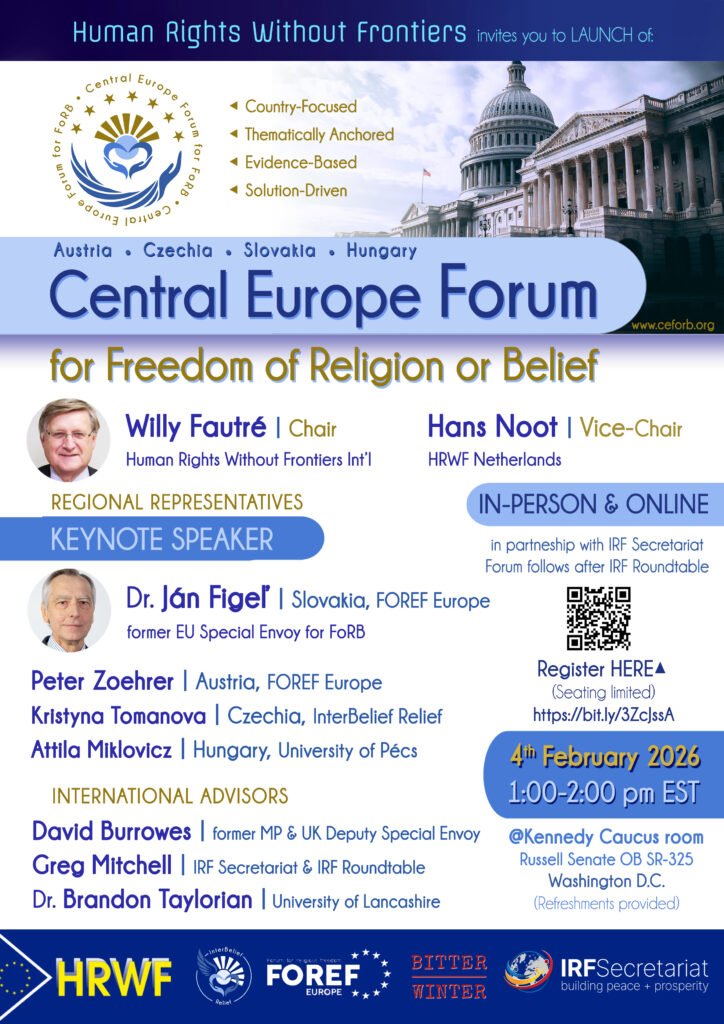
CENTRAL EUROPE FORUM for Freedom of Religion or Belief
Austria · Czechia · Slovakia · Hungary
The Central Europe Forum for Freedom of Religion or Belief is a grassroots-led regional initiative designed to address persistent and emerging FoRB challenges in Central Europe through a structured, repeatable, and transparent working cycle. The Forum functions both in-person and online, enabling sustained regional cooperation while remaining accessible to diverse stakeholders.
The Forum’s core purpose is to bridge the gap between international human-rights commitments and lived realities. While FoRB protections are formally embedded in European and international legal frameworks, their implementation often remains uneven. The Forum responds to this gap by grounding its work in independent evidence, country-specific analysis, and thematically anchored discussions that reflect the actual experiences of faith-based and non-faith-based communities.
Participation in the Forum is subject to approval by the organizing body to safeguard independence, professionalism, and trust. Discussions take place under Chatham House Rules to encourage candor and responsible dialogue. Decisions and outputs do not require consensus, allowing for clarity of analysis and integrity of conclusions.
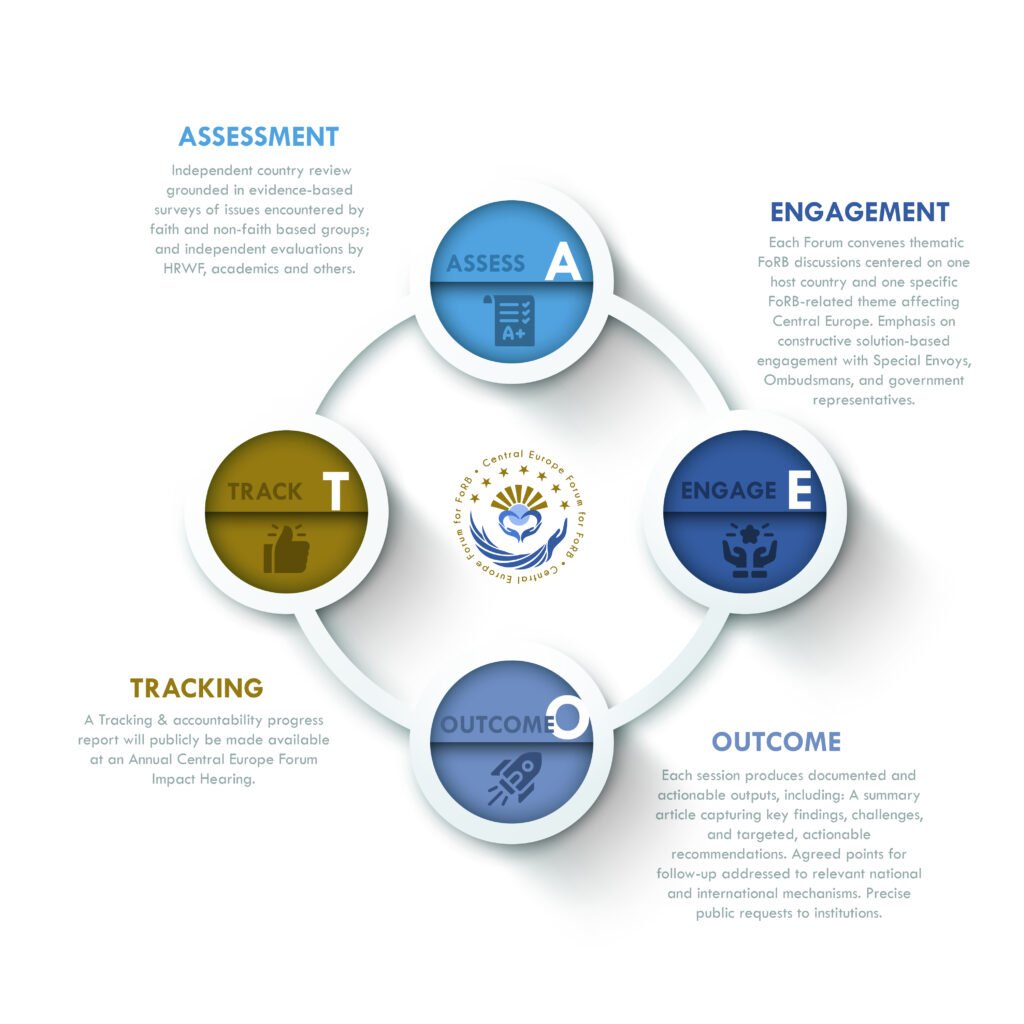
How the Forum Works: The Accountability Cycle
How It Works
Each Forum session initiates a complete accountability cycle consisting of four interlinked stages: assessment, engagement, outcome, and tracking. This cycle is repeated five times per year, ensuring continuity while allowing adaptation to evolving national and regional contexts.
The assessment phase begins with an independent country review. These reviews draw on evidence-based surveys documenting obstacles encountered by religious and belief communities, as well as independent evaluations conducted by Human Rights Without Frontiers and affiliated academics and experts. All assessments are explicitly aligned with OSCE, EU, UN, and ECHR FoRB standards.
The engagement phase centers on one host country and one specific FoRB-related theme relevant to Central Europe, such as registration regimes, hate speech, legal remedies, or best practices. Each session convenes civil society actors, national stakeholders, and international experts, with a strong emphasis on constructive, solution-oriented dialogue. Engagement with Special Envoys, ombudspersons, and government representatives is integral to this phase, enabling direct exchange and comparative learning across countries.
The outcome phase translates discussion into action. Each session produces documented outputs, including a public summary article identifying key findings and challenges, as well as targeted and actionable recommendations. Where appropriate, the Forum formulates precise follow-up requests addressed to national authorities or international mechanisms. When shared positions emerge, participants may pursue collective actions such as joint statements, policy submissions, or coordinated advocacy, while respecting the Forum’s non-consensual decision model.
The tracking phase ensures accountability. Progress is monitored over time, with responses from institutions documented and changes assessed. These findings are presented publicly at an annual Central Europe Impact Hearing, providing transparency regarding who responded, what changed, and which steps remain necessary.
Central Europe Impact Hearing
Once per year, the Forum convenes a Central Europe Impact Hearing to review progress and accountability. Invitees include representatives of OSCE ODIHR, EU and UN institutions, national diplomats, independent experts, media, and civil-society organizations. The Hearing serves as a public checkpoint, reinforcing sustained engagement and evidence-based follow-up.
Governance and Cooperation
The Forum is guided by a Steering Council chaired by Willy Fautré, with Hans Noot serving as Vice-Chair and Eva Miskelova as Council Secretary. Regional leadership is ensured through designated representatives for Austria, Czechia, Slovakia, and Hungary. The Forum is supported by an international advisory group composed of experienced practitioners and scholars in FoRB and human-rights policy.
Human Rights Without Frontiers provides grassroots leadership and methodological grounding. InterBelief Relief coordinates regional implementation, while FOREF Europe serves as a strategic partner. Cooperation with additional partner organizations, media experts, and academic specialists strengthens the Forum’s analytical depth and public outreach.
Looking Ahead
The Central Europe Forum for FoRB is conceived as a long-term, cumulative process rather than a one-off initiative. By combining country focus, thematic depth, and systematic accountability, it aims to contribute to a more consistent, credible, and effective protection of freedom of religion or belief across Central Europe.